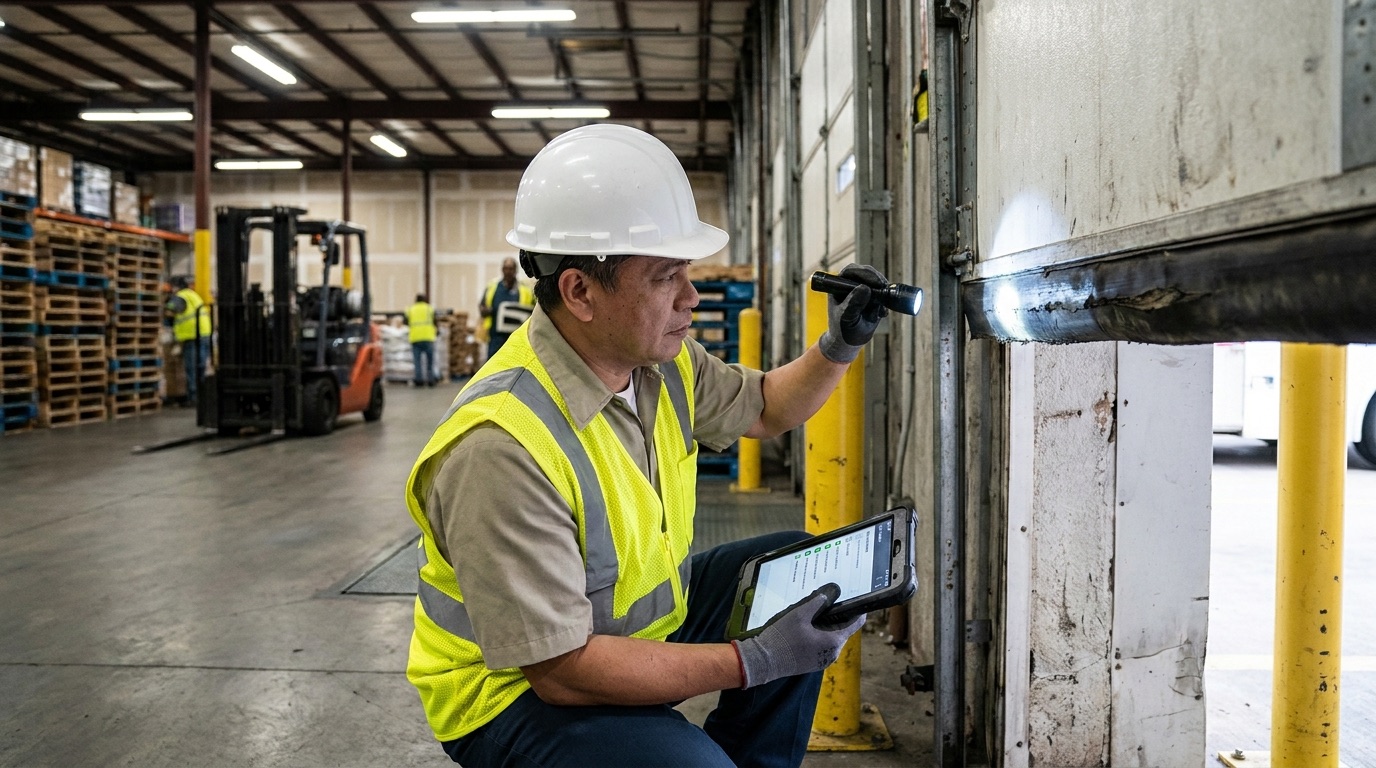
A warehouse viewing usually lasts thirty minutes. The lease you sign afterwards lasts three years. This checklist compresses what professional industrial brokers and facility engineers look for into twenty checks you can run in a single thorough visit — most requiring nothing more than a tape measure, your phone, and the willingness to ask blunt questions.
Structure and floor (checks 1–5)
The building's bones are the hardest thing to fix after signing. Start here.
- 1. Clear height — measure to the lowest obstruction (beams, trusses, ducts), not the apex. Racking plans die on a purlin you didn't notice.
- 2. Floor load capacity — ask for the slab rating in writing; modern parks run ~3 tons/sqm, old converted bodegas can be half that.
- 3. Floor condition — look for cracked joints, spalling, and unevenness; a forklift operation on bad joints bleeds maintenance money.
- 4. Column grid — wide grids (10m+) rack efficiently; tight grids strand pallet positions.
- 5. Roof condition — check for rust streaks, patched sheets, and daylight through the roofing; ask when it was last recoated.
Water and weather (checks 6–9)
In the Philippines, water is the number one destroyer of stored goods. Do not take 'hindi bumabaha dito' at face value — verify.
- 6. Flood history — ask neighboring locators and the barangay hall about the street, not just the property; check UP NOAH flood maps for the area.
- 7. Floor elevation — is the slab raised above road level? Even 300–600mm of elevation has saved entire inventories during habagat rains.
- 8. Gutters and downspouts — undersized or clogged gutters overflow into the building during a typhoon downpour.
- 9. Water stains — look up: stains on trusses and along walls tell you where the roof leaks, regardless of what anyone says.
Access and logistics (checks 10–13)
Your trucks are the lifeblood of the operation. Test the site against your largest vehicle.
- 10. Truck access and turning radius — a 40-footer needs roughly 35m to swing into a dock; walk the approach and check gate width and height.
- 11. Loading bays — count, type (dock-high vs ramp), and whether the apron drains or ponds in rain.
- 12. Road access in wet season — is the last kilometer paved? Provincial gravel access roads can become impassable for loaded trucks in August.
- 13. Truck bans and LGU rules — verify local truck ban hours and weight limits between the site and the highway.
Power, fire, and safety (checks 14–17)
These checks decide both your operating capability and your insurability.
- 14. Power capacity — confirm available kVA in writing and who owns the transformer; upgrading a connection can take months and six figures.
- 15. Fire protection — sprinklers or at minimum a compliant FDAS (fire detection and alarm system); ask for the latest Fire Safety Inspection Certificate.
- 16. Fire exits and extinguisher stations — count them against the floor area; your own permit renewal depends on compliance.
- 17. Security — perimeter fence condition, guardhouse, CCTV coverage, and lighting; ask about theft incidents in the compound.
Paper and permits (checks 18–20)
The final checks happen at a desk, not on the floor — and they are the ones that void deals.
- 18. Ownership documents — TCT or tax declaration matching the lessor's name; Secretary's Certificate/SPA for representatives.
- 19. Zoning and use — confirm the property is zoned industrial or commercial for your use; ask the LGU planning office if in doubt.
- 20. PEZA eligibility — if you hold or plan PEZA registration, the building itself must be PEZA-accredited; a great non-PEZA building is worthless to a PEZA locator.
Run the checklist twice
If a property survives all twenty checks, view it a second time at a different hour — ideally during or just after heavy rain, when drainage, roof, and access-road truths reveal themselves. The one-hour repeat visit is the cheapest insurance you will ever buy on a multi-year lease.
If you'd rather not run this gauntlet alone, Warehouse Hub reps do the inspection legwork with you and flag issues to the owner before contract stage, so problems get fixed or priced in — not discovered after move-in.